IN BRIEF - OCEAN2012 slams fishing subsidies: Consumers are paying for their fish many times over
EUROPEAN UNION
Monday, May 14, 2012
LONDON - Environmental coalition OCEAN2012 has sharply criticised excessive EU fishing subsidies ahead of an EU Fisheries Council Meeting to be held in Brussels next week. Ministers at the meeting will debate how future subsidies should be spent and how to reach sustainable fishing limits.
"Subsidised overfishing has meant subsidised environmental and economic failure. Healthy fish stocks could mean more fishing and more jobs.” said Ian Campbell, UK Coordinator for OCEAN2012, a coalition of over 160 organisations dedicated to ending overfishing in the EU.“We need to redirect our public taxes away from fuelling overfishing and towards restoring the EU's fisheries to their optimal levels, which in turn will increase their profitability.”
"In EU waters 63 per cent of assessed stocks in the Atlantic are overfished. 82 per cent of stocks are overfished in the Mediterranean and four out of the six stocks in the Baltic. This is the result of poor decision-making based on short-term considerations. It is estimated that in the EU overfishing is costing us at least EUR 3.2billion a year, yet in the last five years roughly EUR 13 billion of taxpayers’ money has been spent subsidising the EU fishing sector to increase the capacity of fleets, pay for modernisation, fuel, fees and scrapping. Taxpayers and consumers should know that as things stand, they are paying for their fish many times over."Environmental coalition OCEAN2012 has sharply criticised excessive EU fishing subsidies ahead of an EU Fisheries Council Meeting to be held in Brussels next week. Ministers at the meeting will debate how future subsidies should be spent and how to reach sustainable fishing limits.
Khyber Aquaculture and the Fisheries Department train farmers in sustainable cold-water aquaculture
Khyber Aquaculture and the Jammu & Kashmir Department of Fisheries launched specialised training for trout farmers from Ganderbal, Bandipora and Srinagar, covering biosecurity, water quality, disease prevention and RAS technology to improve survival, growth and farm efficiency.
The initiative aims to boost trout productivity and develop the region as a hub for sustainable cold-water fisheries.
New infrastructure aims to improve fuel access and operational efficiency for local fishermen.
Bahrain has begun work to install fuel pumps at four fishing jetties, strengthening essential infrastructure for the fishing sector. The project will provide fishermen with easier access to fuel directly at key landing sites, supporting daily operations and improving services for the local fleet.
Chinese shipbuilder Rongcheng Xinyang will strengthen Tanzania’s offshore fishing capacity
Tanzania Fisheries Corporation (TAFICO) signed a contract with China’s Rongcheng Xinyang Ship Industry Limited to build two deep-sea fishing vessels. The IFAD-funded AFDP project aims to boost fisheries productivity, expand use of marine resources and support Tanzania’s Blue Economy and Vision 2050.
The two men were rescued around 150 miles off Chiapas after their vessel sank.
The men endured days without food or fresh water after their vessel sank off Mexico’s southern Pacific coast.
Two Mexican fishermen, aged 53 and 32, survived five days adrift in the Pacific Ocean by clinging to and sheltering in a large fishing cooler after their boat sank. The Mexican Navy located them about 150 miles off Chiapas and carried out their rescue. Both men, weakened and suffering from severe dehydration after days without food or fresh water, received medical assistance and were transported safely to shore.
Border Force detained the crew near Cape York after finding fishing gear and 700 kg of salt
The Australian Border Force (ABF) seized the vessel near Little Adolphus Island, Torres Strait. Authorities found fishing equipment and 700 kg of salt, but intercepted it before marine life was caught. The crew was taken to Darwin for investigation. In 2026, 24 suspected illegal foreign fishing boats have been intercepted in Far North Queensland, with 14 destroyed.
The Federal Service for Veterinary and Phytosanitary Surveillance of the Russian Federation (Rosselkhoznadzor)—which inspected nine Chilean processing facilities and their entire associated supply chains, including farming centers, cold storage plants, and processing sites—has announced the lifting of restrictions on five facilities, allowing them to resume exports to that market.
For the National Fisheries and Aquaculture Service (Sernapesca), this announcement “represents significant progress in the process of implementing the adopted corrective measures” and reflects the outcome of collaborative efforts to strengthen the official control system and ensure compliance with requirements established by the Eurasian Economic Union and the Russian Federation.
Source: Industrias Pesqueras | Read the full article here
Sashimi rules the salmon category in China, according to NSC research, offering an opening for salmon imports
Ahead of World Seafood Shanghai (WSS), taking place from 26–28 August, the Norwegian Seafood Council (NSC) has pinpointed sashimi as a key opportunity in China’s rapidly expanding salmon market. This is being driven by rising in-home consumption, fast delivery services and the parallel growth of factories providing sashimi-grade salmon to meet demand.
Austevoll Seafood, the global-based majority owner of the Lerøy Seafood Group has again strongly rejected allegations of salmon price fixing going back several years – but the company adds that there is still no timetable for the European Commission to resolve the issue.
Writing in its second quarter financial report under the heading “special considerations”, Austevoll said it was not possible to “at this stage to make any statement on whether the case will result in sanctions or other negative consequences for the group, or when the case will end”.
Author: Vince McDonagh / Fish Farmer | Read the full article here
In the first half of 2026, the share of production fish - fish that have wounds, deformities or other quality defects when harvested - was 10.6% of the harvest volume, compared to 17.7% in the first half of 2025 and 30% in the first half of 2024. At the same time, the harvest volume is at a record high.
Production fish cannot be sold directly for normal consumption, but must be corrected through processing before they can be sold as food.
Source: fishfarmingexpert | Read the full article here
Strong demand for frozen fish, squid, sardines and live crustaceans drives rapid trade growth
Pakistan’s seafood exports to China reached $220 million in the first seven months of 2026, up 41% from $156 million a year earlier. Frozen fish led exports at $40.04 million, followed by cuttlefish and squid at $36.39 million. Around 200 Pakistani seafood exporters are now registered with Chinese customs.
Illex Squid Closure Reshapes Atlantic Commercial Season United States
NOAA limits directed fishery through year-end after projecting 96% of domestic quota will be harvested
The directed fishery for Illex squid (Illex illecebrosus) is formally closed in United States fe...





 EUROPEAN UNION
 INDIA
INDIA.png) Khyber Aquaculture and the Fisheries Department train farmers in sustainable cold-water aquaculture
Khyber Aquaculture and the Fisheries Department train farmers in sustainable cold-water aquaculture BAHRAIN
 New infrastructure aims to improve fuel access and operational efficiency for local fishermen.
 TANZANIA
.png) Chinese shipbuilder Rongcheng Xinyang will strengthen Tanzania’s offshore fishing capacity
Chinese shipbuilder Rongcheng Xinyang will strengthen Tanzania’s offshore fishing capacity MEXICO
 The two men were rescued around 150 miles off Chiapas after their vessel sank.
 AUSTRALIA
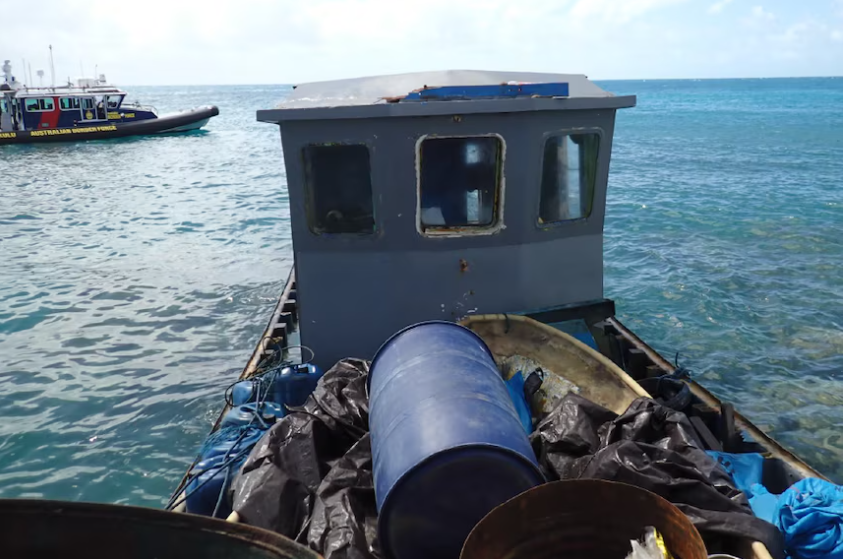 Border Force detained the crew near Cape York after finding fishing gear and 700 kg of salt
 RUSSIAN FEDERATION
 The Federal Service for Veterinary and Phytosanitary Surveillance of the Russian Federation (Rosselkhoznadzor)—which inspected nine Chilean processing facilities and their entire associated supply chains, including farming centers, cold storage plants, and processing sites—has announced the lifting of restrictions on five facilities, allowing them to resume exports to that market.
 CHINA
CHINA Ahead of
  NORWAY
 Austevoll Seafood,
 In the first half of 2026, the share of production fish - fish that have wounds, deformities or other quality defects when harvested - was 10.6% of the harvest volume, compared to 17.7% in the first half of 2025 and 30% in the first half of 2024. At the same time, the harvest volume is at a record high.
 PAKISTAN
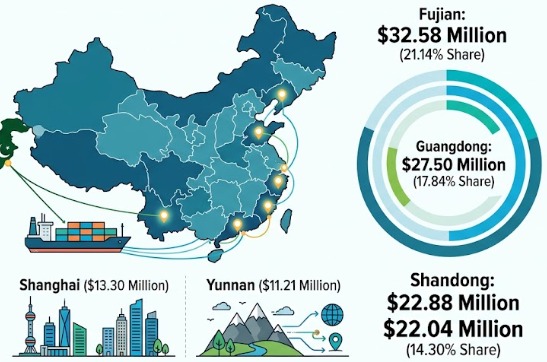 Strong demand for frozen fish, squid, sardines and live crustaceans drives rapid trade growth