Other Media | iPac.acuicultura: Seafood Europe calls for strengthening EU production and ensuring reliable international trade to supply the European
EUROPEAN UNION
Thursday, November 12, 2026
Consumption of seafood products in the EU rose by 2% in 2025, while the self-sufficiency rate fell to 32%, highlighting an increasing reliance on imports.
The European Union is becoming ever more dependent on international suppliers to meet its demand for fish and aquaculture products, according to the *EU Seafood Supply Synopsis 2026* report, published by Seafood Europe—an organization representing the European seafood processing and marketing industry.
In 2025, the consumption of seafood products in the EU increased by 2% compared to 2024.
Source: iPac.acuicultura | Read the full article here
The plaintiff, a private foundation, is claiming nearly 24 billion euros for all catches made since 1989.
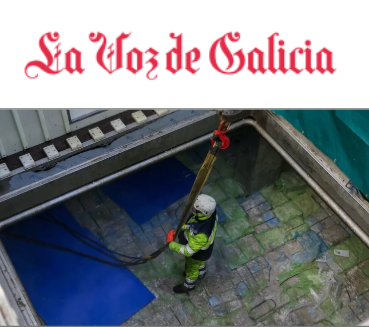
Mariel Borruto, the judge presiding over the Federal Court of Río Grande in Tierra del Fuego, has prohibited twelve Galician fishing companies from operating in the waters of the Falkland Islands without authorization from Argentina. The companies currently operate there under licenses granted by the Falkland Islands government. The injunction, issued on November 6, also applies to seven joint ventures between Spanish and Falkland Islands entities. It covers Argentina’s territorial sea and exclusive economic zone—including the waters surrounding the archipelago—up to the 200-mile limit. The order further bans on-board processing, transshipment, unloading, the addition of new vessels to fleets, and the commencement of new fishing voyages.
Author: Cecilia Valdez / La Voz de Galicia | Read the full article here
Icelandic salmon producer Kaldvík recorded an €11.5 million biomass write-down in the third quarter following a jellyfish outbreak at its Reyðarfjörður farms, pushing its net loss to €18.8 million despite a near-tripling of harvest volumes.
The company reported revenue of €26.1 million, up from €9.9 million a year earlier, while its operational EBIT loss narrowed to €3.8 million from €5 million, excluding the biomass write-down, according to results published on Friday.The net loss widened from €11.1 million in the corresponding period last year. For the first nine months, Kaldvík reported a cumulative net loss of €60.9 million, compared with €33.9 million a year earlier.
Source: SalmonBusiness | Read the full article here
Ode has formed a joint venture with Namdal Settefisk to expand into Trøndelag, with scope to more than double the production capacity of six farming sites.
Ode has acquired a 51 percent stake in Namdal to expand farmed cod production into Central Norway. The new company, Ode Namdal AS, will operate as a fully integrated subsidiary of Ode and develop six sea sites in the region.The sites’ current production capacity is 11,700 tonnes, with the potential to grow to more than 25,000 tonnes over time, taking Ode’s total annual production capacity to more than 60,000 tonnes.
Source: The Fish Site | Read the full article here
Salmon farmer Grieg Seafood expects that the addition of poultry-based ingredients will reduce the impact of increased feed prices by 50% this year, it said in an extended trading update for the third quarter of 2026.
The cancellation of anchoveta fishing seasons in Peru because of the El Niño climate event has pushed the price of aquafeed marine ingredients up, and substituting some of those with poultry meal helps mitigate that extra cost.
Author: Gareth Moore / fishfarmingexpert | Read the full article here
Several U.S. markets recorded price declines during the week following the elections, while the Democratic Party's gains raised expectations of a more favorable political environment for certain segments of the industry.
The election results could significantly influence future decisions concerning seafood trade, fisheries management, environmental regulations and federal support programs.
With Democrats preparing to assume control of Congress in January 2027, industry representatives will be watching developments involving the 2027 federal budget, the Farm Bill and funding for the National Oceanic and Atmospheric Administration (NOAA).
Author: Erin Spampinato / SeafoodSource | Read the full article here
Cooke Aquaculture has hit out at what it says are misleading claims about the industry on social media by at least two anti-salmon farming groups.
The company points the finger at the Atlantic Salmon Federation and Wildfish UK’s “Off the Table” campaign which it claims are deceiving consumers.
Cooke Aquaculture said: “It has come to our attention that these organisations are receiving money from foundations and individuals with the intent to disrupt food security, harm seafood farmers’ jobs, and the local businesses that supply vital goods and services to the aquaculture food farming sector in coastal communities globally.
Author: Vince McDonagh / Fish Farmer | Read the full article here
In 2025, the company used ROV technology to replace 2,469 theoretical annual dives in mooring operations and to perform more than 1,000 underwater interventions remotely.
In 2025, Ventisqueros made progress in incorporating underwater robotics to perform operational tasks at its aquaculture facilities, reducing the need for diving operations related to anchoring and infrastructure maintenance.
Through the use of ROV (remotely operated vehicle) systems, the company was able to replace 2,469 theoretical annual dives in mooring operations, thereby preventing workers from being exposed to the risks associated with these tasks.
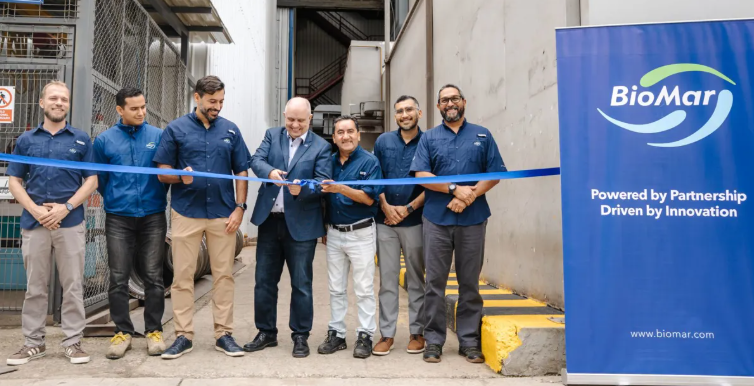
BioMar Ecuador has officially inaugurated the first phase of its facility expansion on 29 October, scaling up manufacturing capacity to satisfy escalating local demand for high-performance shrimp feed.
The milestone advances the company’s strategic program to elevate annual plant capacity from 300,000 to 410,000 tonnes during 2026 by optimizing current infrastructure and commissioning a new line, backed by toll-milling partnerships.
"Ecuador is one of the most important shrimp markets globally, and we see strong potential for continued growth," stated Henrik Aarestrup, VP LATAM Shrimp & Hatchery at BioMar.
BioMar Ecuador has broadened its client portfolio from small and medium-sized farms to long-term partnerships with leading producers. Managing Director Andres Rivadulla emphasized that the opening establishes the platform for the next development phase, which is slated to incorporate an additional 200,000 to 300,000 tonnes of capacity alongside extensive site infrastructure improvements.
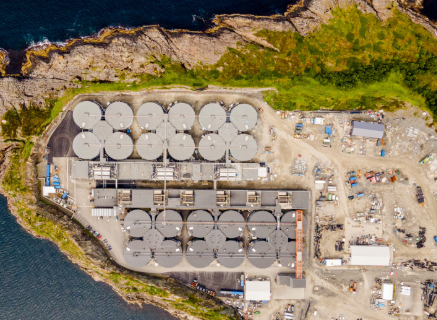
Land-based salmon farmer Salmon Evolution (OSE: SALME) continues to progress its Phase 2 ramp-up at Indre Harøy, having recently completed the handover of four new tanks. This milestone brings the facility's total operational capacity to eight tanks.
The expansion project remains on schedule. The next two tanks are set to enter operation later this quarter, while the final two tanks are scheduled to become operational in Q1 2027.
Preparations for upcoming biomass introductions are well underway. Approximately 560,000 smolt are scheduled for stocking over the coming weeks. This will lift total planned 2026 stocking volume at Indre Harøy to approximately 2.8 million smolt, up sharply from around 1.7 million stocked in 2025.
Salmon Evolution remains focused on meeting combined Phase 1 and Phase 2 production targets, aiming to leverage increased production volumes to drive down unit operating costs. The company maintains harvest guidance of 11,000 to 12,000 tonnes HOG for 2027, targeting full production run-rate by mid-2027.
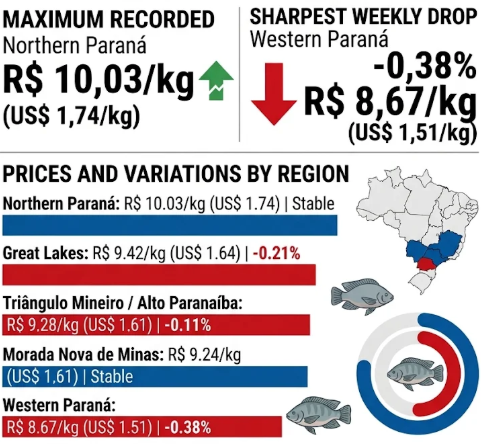
Western Paraná registers the largest weekly drop, of 0.38%
Farm-gate prices for Nile tilapia (Oreochromis niloticus) registered minor fluctuations across major Brazilian producing regions monitored by the Center for Advanced Studies in Applied Economics (Cepea) during the week of November 2nd to 6th, 2026.
Western Paraná recorded the sharpest weekly drop, easing 0.38% compared to the previous week to stand at R$ 8.67 (US$ 1.51) per kilogram. Downward adjustments were also observed in the Great Lakes region, where prices fell 0.21% to R$ 9.42 (US$ 1.64)/kg, and in Triângulo Mineiro and Alto Paranaíba, which slipped 0.11% to R$ 9.28 (US$ 1.61)/kg.
Conversely, values held firm across other monitored basins. Quotes in Morada Nova de Minas remained stable at R$ 9.24 (US$ 1.61)/kg, while Northern Paraná commanded the market peak at R$ 10.03 (US$ 1.74)/kg, according to official benchmark data compiled by Cepea.
Norway Pelagic Fisheries Report, Week 45 Norway
Norwegian spring-spawning herring supply contracts by 44.6% in Norway amid quota closures and gales
Landings of spring-spawning herring fell to 19,609 tonnes during week 45, as the small-scale fleet ...



 EUROPEAN UNION
.png) Consumption of seafood products in the EU rose by 2% in 2025, while the self-sufficiency rate fell to 32%, highlighting an increasing reliance on imports.
 ARGENTINA
 Mariel Borruto, the judge presiding over the Federal Court of Río Grande in Tierra del Fuego, has prohibited twelve Galician fishing companies from operating in the waters of the Falkland Islands without authorization from Argentina. The companies currently operate there under licenses granted by the Falkland Islands government. The injunction, issued on November 6, also applies to seven joint ventures between Spanish and Falkland Islands entities. It covers Argentina’s territorial sea and exclusive economic zone—including the waters surrounding the archipelago—up to the 200-mile limit. The order further bans on-board processing, transshipment, unloading, the addition of new vessels to fleets, and the commencement of new fishing voyages.
 ICELAND
 Icelandic salmon producer
 NORWAY
.png) Ode
.png) Salmon farmer
 UNITED STATES
 Several U.S. markets recorded price declines during the week following the elections, while the Democratic Party's gains raised expectations of a more favorable political environment for certain segments of the industry.
 CANADA
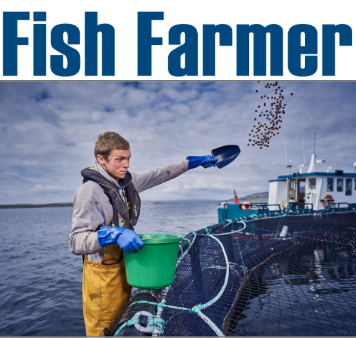 Cooke Aquaculture
 CHILE
.png) In 2025, the company used ROV technology to replace 2,469 theoretical annual dives in mooring operations and to perform more than 1,000 underwater interventions remotely.
 ECUADOR
 BRAZIL