|
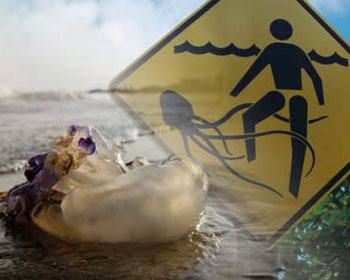
Several European beaches had to be closed in Summer due to jellyfish proliferation. (Photo: Norbert Wu, Minden/Magebroker/FLPA/Ocean2012)
Sardine and anchovy overfishing facilitates jellyfish proliferation
 (EUROPEAN UNION, 8/24/2011)
The alliance of environmental organizations, Ocean2012, presented a report in Spain that analyzes the causes for jellyfish population to multiply without control in some European coastal zones, including in Spain.
The report called How overfishing affects you, reveals results that have been backed by scientific journals such as Trends in Ecology & Evolution.
The organization quotes the document Through the jellyfish’s park: causes, consequences and management responses for a more gelatinous future, which describes the keys to jellyfish population increase.
This paper argues that massive fishing for sardines and anchovies may reduce predation pressure on jellyfish and, at the same time, increase its food source.
In addition, OCEAN2012 considers the research by scientist Daniel Pauly, who explains the toxic algae and jellyfish proliferation phenomenon because of overfishing towards lower levels of the ecosystem.
According to Pauly, as bigger fish are scarce the food chain is descended to reach the final stage, also by trawl fishing, and waters are subject to counterproductive microbiological processes.
In addition, the corrective effect that could be experienced by some species, such as sea turtles, does not occur because they are also endangered by overfishing. All this tends to lead to the uncontrolled proliferation of jellyfish.
Moreover, OCEAN2012 complains that the European fleet has a capacity of allowable catch that exceeds between two and three times the sustainable level.
In this sense, the European Commission recognizes that 63 per cent of fish stocks from the Atlantic are overfished and this percentage reaches 82 per cent in the Mediterranean.
Just on these shores, in 2010, local officials were forced to close beaches in the Mediterranean and in the Black Sea during the summer tourist season owing to jellyfish proliferation.
However, a report from Higher Council for Scientific Research (CSIC) argues that we must analyze the jellyfish own cycles and not only human factors as the causes of the multiplication of the specimens.
Related articles:
- Jellyfish drastically change marine food webs: study
- Experts urge drop in small fish harvesting
By Silvina Corniola
editorial@seafood.media
www.seafood.media
Information of the company:
|
Address:
|
c/o European Marine Programme of the Pew Environment Group The Pew Charitable Trusts Square du Bastion 1A boîte 5
|
|
City:
|
Brussels
|
|
State/ZIP:
|
(1050)
|
|
Country:
|
Belgium
|
|
Phone:
|
+32 (0)2 274 1620
|
|
E-Mail:
|
info@ocean2012.eu
|
More about: 
|
|
|
|








 Print
Print