|
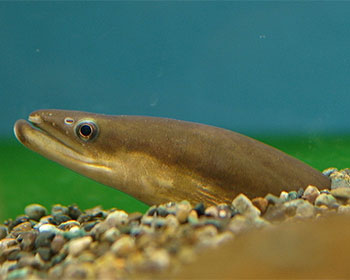
Japanese eel, Anguilla japonica (Photo Credit: Opencage CC BY-SA 3.0)
Japanese eel listed as an endangered species
 (JAPAN, 6/18/2014)
The country’s most expensive food fish, the Japanese eel (Anguilla japonica), has been classified as endangered due to loss of habitat, overfishing, barriers to migration, pollution and changes to oceanic currents.
This traditional Japanese delicacy, known as nihon-unagi, has just been listed on an international "red list" of endangered species by the International Union for Conservation of Nature (IUCN).
"East Asia is a hub for farming, trade and consumption of this species and its decline has meant that trade in other eel species, such as the shortfin eel (A. bicolor) has increased, IUCN pointed out in a statement.
“While the status of this species is of great concern, the assessment of the Japanese eel and other eels is a hugely positive step,” says Dr Matthew Gollock, Chair of the IUCN Anguillid Specialist Sub-Group. “This information will allow us to prioritise conservation efforts for eel species and the freshwater ecosystem more broadly.”
For his part, Yoshimasa Hayashi, the minister of Agriculture, Forestry and Fisheries, called for additional efforts to boost populations of eels in native waters, AP informed.
"We must speed up efforts to build large-scale production systems," Hayashi stressed after the IUCN's decision was announced.
Japan is responsible for roughly 70 per cent of the eel consumed worldwide.
Efforts to farm eels have made slow progress due to their complicated migratory patterns. Unlike salmon, which migrate inland to spawn but spend their lives at sea, eels are spawned in remote areas of the ocean and then migrate inland, only returning to the sea to reproduce.
Japanese eel are usually raised to adulthood after being caught as elvers, or glass eels. Although there are limits on catching elvers and juvenile eels, demand has soared, putting heavy pressure on the species, as well as many other fish stocks and pushing prices for elvers.
In turn, prices for mature eels have soared, turning the traditional "kabayaki" roasted eel dish, with a tangy sauce on top, into a luxury rather than common household dining.
UICN's measures may lead to the species being banned from international trade by the Washington Convention, also known as the Convention on International Trade in Endangered Species of Wild Fauna and Flora (CITES).
These issues will be among those discussed at a US-led "Our Ocean" conference in Washington, D.C., stated David Balton, a deputy assistant U. secretary of state.
"A third of all major fish stocks are overfished and another 50 per cent are fished at their limit and are in danger of being overfished," Balton said on a conference call. "The situation for fisheries around the world is not a good one. We need to act to end overfishing."
Elvers are caught in rivers in Asia and other regions and provided as seed stock for aquaculture. They are a lucrative fishery for New England, in the US, where quotas have been set to prevent overfishing.
According to The Japan Times, in order to save the Japanese eel, surveillance of trade in eels, both processed and unprocessed, will also need to be tightened, given that Japan imports juvenile eels from overseas and eels are farmed in other parts of Asia such as China, South Korea and Taiwan for export to Japan.
editorial@seafood.media
www.seafood.media
Information of the company:
|
Address:
|
Rue Mauverney 28
|
|
City:
|
Gland
|
|
State/ZIP:
|
(1196)
|
|
Country:
|
Switzerland
|
|
Phone:
|
+41 22 999 0000
|
|
Fax:
|
+41 22 999 0002
|
|
E-Mail:
|
webmaster@iucn.org
|
More about: 
|
|
|
|








 Print
Print